Penetration Bias Correction in X-band InSAR DEMs (Greenland)
A hybrid AI-physical method to correct penetration bias in X-band InSAR digital elevation models over the Greenland Ice Sheet.
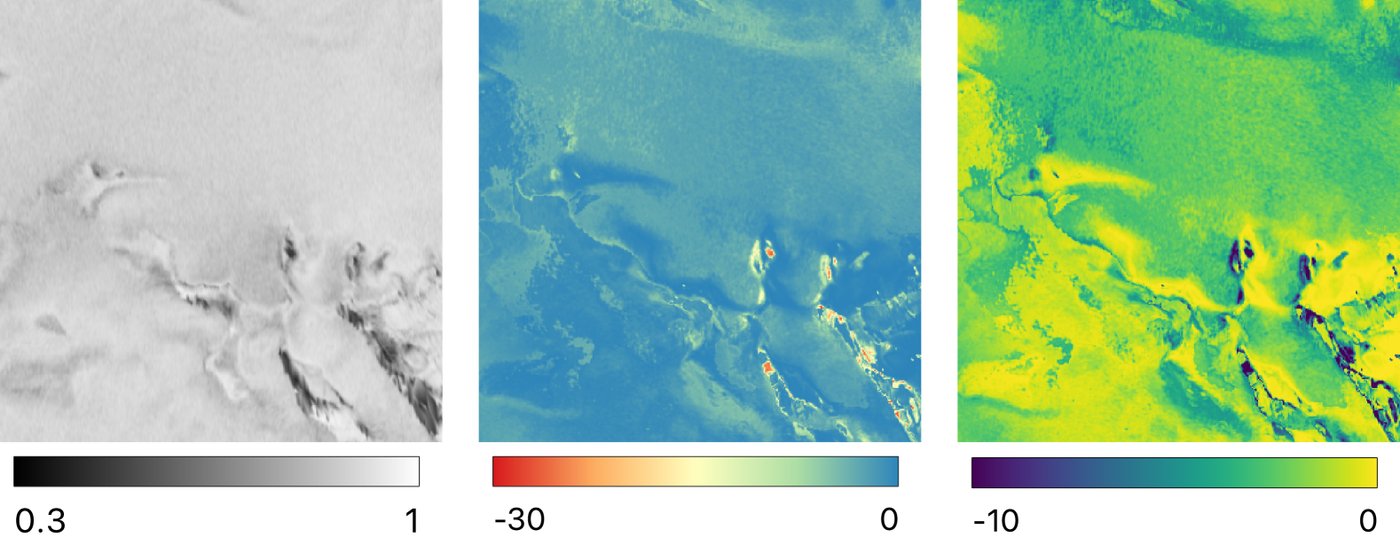
Developed as part of PhD research at DLR / ETH Zürich, combining physics-based scattering models with machine learning to correct systematic elevation bias caused by radar signal penetration into snow and ice, improving X-band InSAR DEM accuracy over the Greenland Ice Sheet.
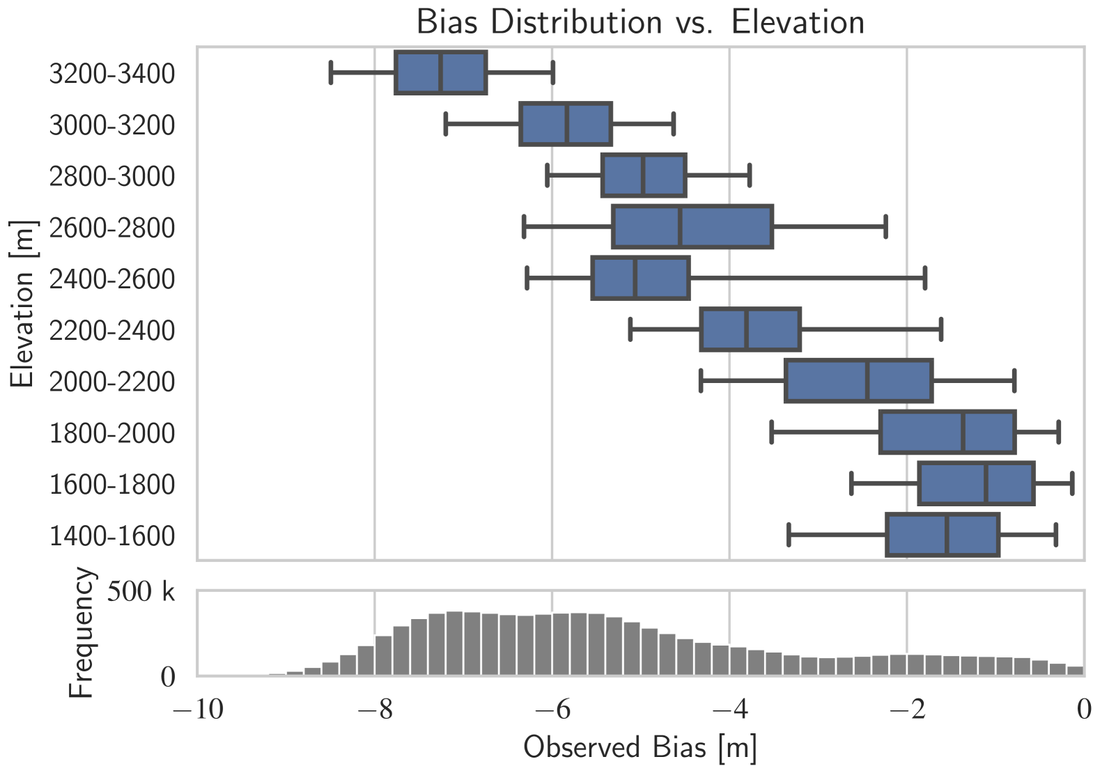
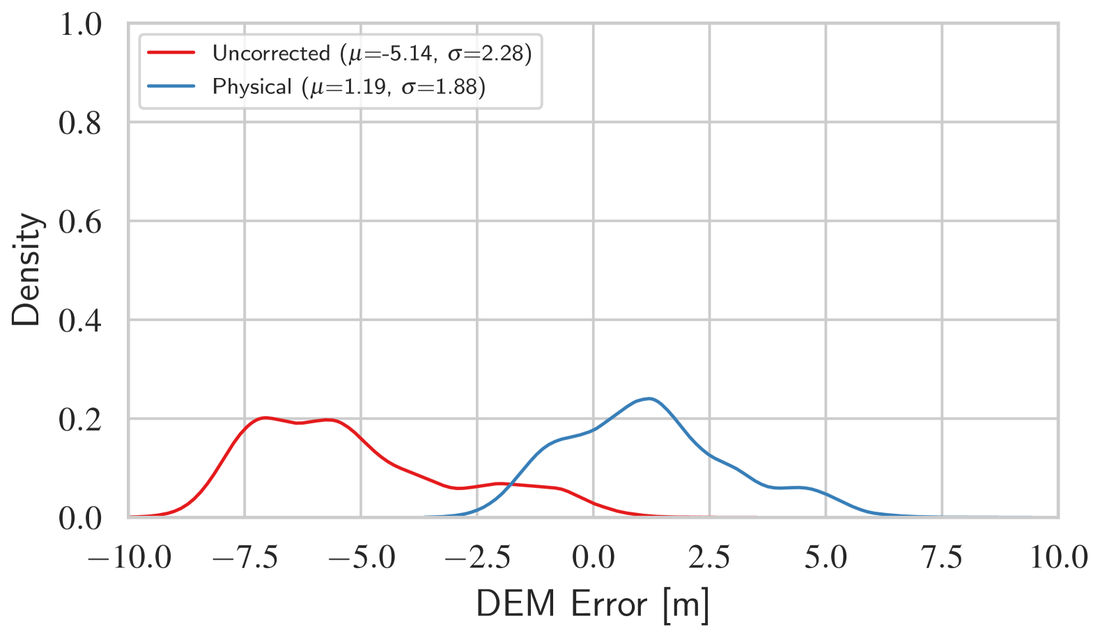
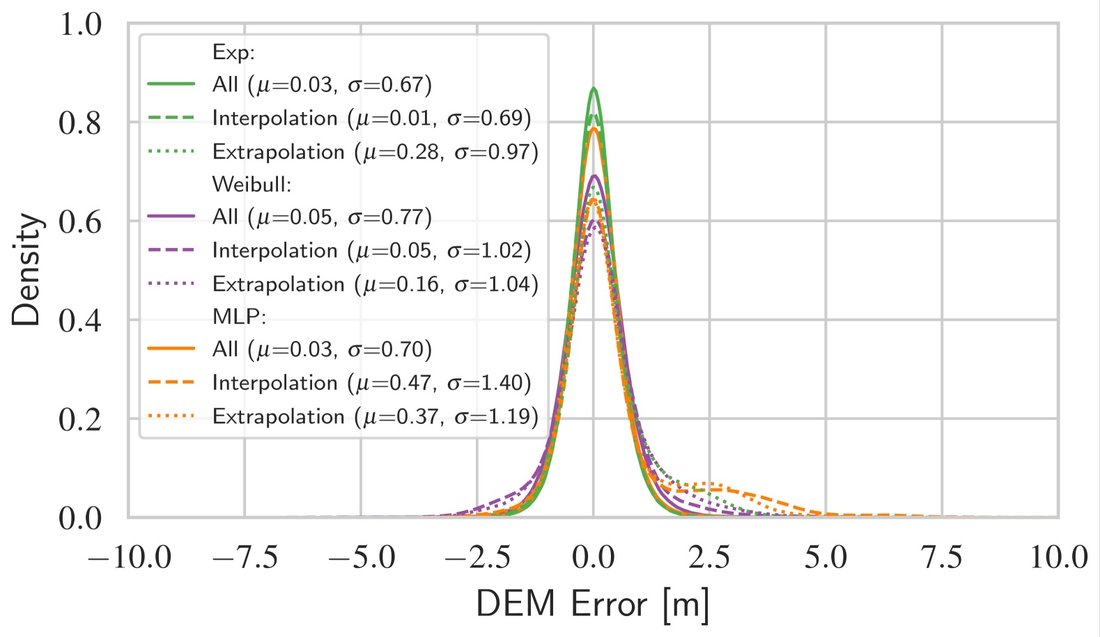
Published as “Hybrid AI-Physical Modeling for Penetration Bias Correction in X-band InSAR DEMs: A Greenland Case Study” (with Georg Fischer, Ronny Hänsch, and Irena Hajnsek), extending an earlier conference paper presented at IGARSS 2024. An MLP predicts the parameters of a physical vertical scattering profile (the Exponential/Uniform-Volume model, and a more flexible Weibull profile) from InSAR observables — coherence, incidence angle, vertical wavenumber, interferometric phase, and backscatter — rather than regressing the penetration bias directly. The predicted parameters feed back into the physical model to compute the estimated bias, combining the interpretability and physical grounding of model-based inversion with the flexibility of a learned, data-driven fit.

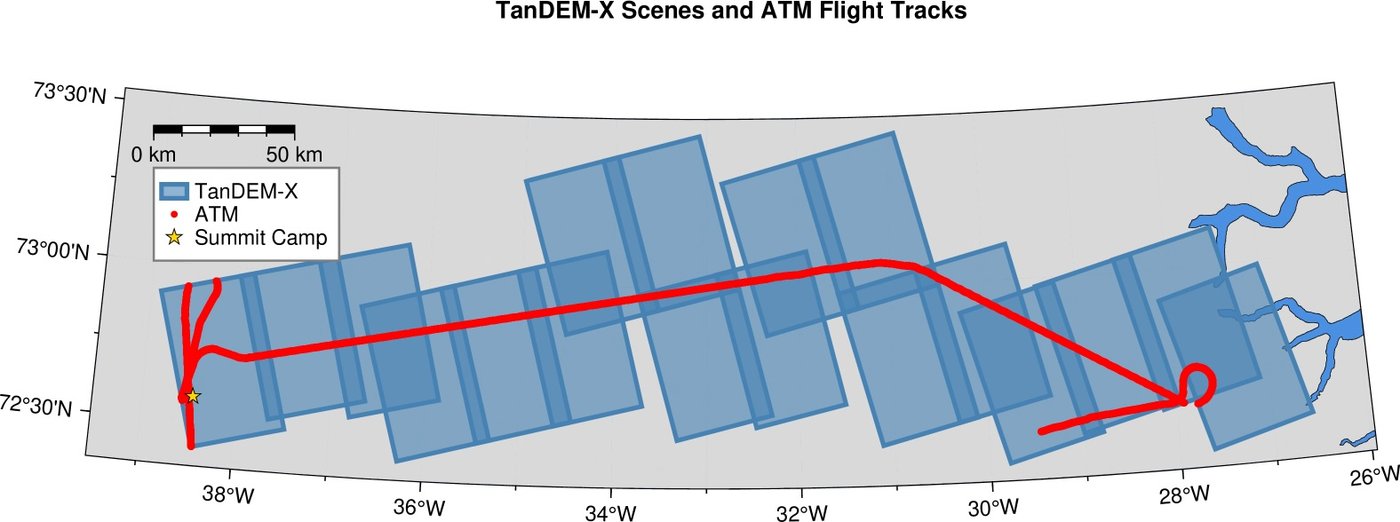
The model is trained and evaluated on 18 TanDEM-X acquisitions spanning a transect from the Greenland ice sheet summit to the east coast (winter 2017), using NASA IceBridge ATM LiDAR elevations as reference. To test generalization to real operational conditions, three training scenarios progressively withhold Height-of-Ambiguity (HoA) ranges: training on the full range, an interpolation test excluding mid-range HoA, and an extrapolation test excluding high HoA values.
References
- Hybrid AI-physical Modeling for Penetration Bias Correction in X-band InSAR DEMs: A Greenland Case Study . 2025 IEEE/CVF Conference on Computer Vision and Pattern Recognition Workshops (CVPRW) , 2025 .
- Correction of The Penetration Bias for InSAR DEM Via Synergetic AI-Physical Modeling: A Greenland Case Study . IGARSS 2024 – 2024 IEEE International Geoscience and Remote Sensing Symposium , 2024 .